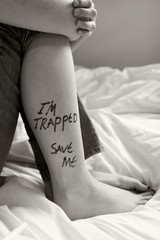
Last year saw a dramatic 11 per cent increase in male deliberate self-harm cases, the National Suicide Research Foundation has revealed. In total, 11,700 deliberate self-harm presentations involving 9,218 individuals of both genders were made to hospital emergency departments in 2008.
The Annual Report of the National Registry of Deliberate Self Harm, published on July 20, found the national person-based rate of self harm increased by 6 per cent, from 188 per 100,000 in 2007 to 200 per 100,000 last year. The strongest increase in self-harm was observed in men, with a rise of 11 per cent (180 per 100,000 in 2008 compared to 162 per 100,000 in 2007). This is the highest rate since the start of the Registry in 2002. Among women, the increase was 4 per cent.
The report revealed that almost half of presentations were by people under 30, with the peak rate for women in the 15-19 age group and for men in the 20-24 age group. An increase in self harm was also observed amongst those aged as young as 10-14 years.
The incidence of deliberate self-harm was highest in HSE Dublin/North East and lowest in HSE South. City rates generally exceeded those of the counties, particularly for men.
The proportion of deliberate self-harm patients who left the emergency department without admission had increased, with particular concern for those who used highly lethal methods, such as attempted hanging and drowning. The admission rates varied considerably across hospitals and HSE regions reflecting a ‘lack of uniform assessment procedures’ for this patient group, the report said.
This is a video on self-harm I made to help those who don't understand. Please check it out and ask any questions if you have any. If there is hate comments, rude or disrespectful I will delete and block you. Below I have posted a lil more details about those who self-harm. Please take a moment to read it. http://www.recoveryourlife.com/ http://www.meetup.com/ http://www.psyke.org
SI is something I go through personally everyday of my life. I think about it all the time. Even tho the thoughts are there, most likely I'll be able to control myself & not hurt my body. Sometimes I slip & hurt myself but it shows how hard I work towards being heathly & safe. DBT is a good source to help the urges & to find safe ways to cope with the feeling.
Self-injury or self-harm is when somebody damages or injures their body on purpose. Self-injury is a way of expressing deep emotional feelings or problems that build up inside.
Cutting the skin is probably the most common form of self-injury. The cuts are not usually deep but in some cases, medical attention is needed to clean, dress or stitch the wounds. The most common places on the body to cut are the wrists, upper arms, inner thighs and upper chest. Less common are the face, breasts, abdomen and genitals.
Often people who cut themselves will use one or two methods, for example, knives, glass or razor blades. The person tends to have a certain area of the body that they prefer to cut, such as the arms.
Burning the skin (usually with cigarettes) is also common. People may also self-harm by scratching, hitting or punching, sometimes using an object. Other forms of self-injury include picking at the skin, pulling out hair, swallowing poisonous substances, taking an overdose of tablets or drugs or deliberately breaking bones.
Although, there is a connection between self-harm and suicide, the majority do not risk their lives. For many people who self-injure, their actions are only an attempt to cope with the stress and difficulties they face; their purpose is not to end their life.
However, there is a possibility that those who self-injure may commit suicide either deliberately or accidentally as the result of their actions.
Self-harm is much more common among girls than boys, often starting in adolescence (between 13 and 18 years of age), although it can affect children from as young as 11 years. Fear of discovery, shame and embarrassment often means that people keep self-injury a secret. Because of this, it is difficult to know how many people self-harm.Some people self-harm only once or a few times while others do it on a regular basis, sometimes throughout their life.
People who self-injure are very careful to hide the damage and scars. They will often injure themselves in places that can be easily hidden by clothing so friends and family members may be unaware of the person self-injuring in private. Another sign that someone could be self-harming is that the person will insist on keeping covered up at all times, even in hot weather.
People self-injure for a variety of reasons and sometimes, the person doesnt actually know why they are doing it. However, it is commonly thought to provide a release for pent-up emotions and feelings. For some people it is their way of coping with a specific problem. Self-injury is a sign of emotional distress and is not an attempt to seek attention.
People who self-harm often describe feelings of numbness or deadness or they may feel detached from reality, as if they are not part of the world. Some may injure themselves to stay separated from reality but others do it to make them feel more real, connected and alive.People who self-harm often describe feelings of numbness or deadness or they may feel detached from reality, as if they are not part of the world. Some may injure themselves to stay separated from reality but others do it to make them feel more real, connected and alive.
People who self-injure risk infections if their wounds are not treated properly. Cuts can become infected if a person uses non-sterile or dirty cutting instruments.
I had a client once, beautiful, vibrant. Her father (perfectionist, career man) sounded proud of her recovery, her determination to not cut. After our session was finished he confided 'Im not really concerned about the self harm business. I read that its a teen thing and I'm sure she will grow out of it'
The relationship between self-harm and suicide is complex. Most commonly the motivation for self-harming behaviour is to cope with, or to gain a sense of relief from painful emotions and distressing personal experiences, not to result in death.
Any action that is deliberately intended to cause death is best regarded as a suicide attempt.vii Any deliberate attempt on one’s life that results in death is best understood to be a suicide.
Since most self-harm experts agree that self-harm and suicide are distinct and separate acts, some have suggested that self-harm should be established as an independent clinical syndromeviii.
According to published research, more than half of individuals who self-harm do not have suicidal thoughts at the time of self-harm and self-harm has been described as a way to avoid suicideix. In one studyx a participant reported that her self-harming behaviours helped her to feel more ‘in control’ whereas her suicidal behaviour occurred when she felt out of control.
This being said, acts of self-harm need to be taken seriously. Individuals who self-harm may be considered at higher risk of further, more severe self-harm and later suicidexi. Self-harm and suicide attempts can be performed by the same individual – and in some cases the intent may not be completely clear. A British studyxii observed that 16% of people who self-harm repeat their self-harm within one year and 7% suicide within nine years.
Regardless of the specific intent in any single instance, acts of self-harm or attempted suicide reflect a degree of emotional distress by an individual that requires skilled assessment and support.
Myth: Self-harm is just a way of attention seeking.
Fact: Self-harm is a coping strategy. People self-harm because they are finding something difficult and painful. They could also be trying to show that something is wrong. They need to be taken seriously. Myth: Self-harm is rare in young people.
Fact: Lots of people self-harm. There is lots of secrecy around self-harm and because many young people do not tell anyone, it is hard to know exactly how many are self-harming. The Royal College of Psychiatrists (1999) found that as many as one in 10 teenagers have deliberately self-harmed. Myth: Young people self-harm over trivial reasons.
Fact: All self-harm should be treated seriously. People self-harm to different extremes as it is a coping strategy and everybody is unique. The extent of the self-harm is not necessarily a reflection of the seriousness of the person’s difficulties. Myth: Once you have self-harmed you cannot stop.
Fact: People can self-harm just once or twice. Some use self-harm over a long period of time. The frequency of the self-harm varies. Many people do stop self-harming but only when they are ready. This could be when they sort their problems out or when they find other ways to deal with their feelings.
Source: The Learning Mentor’s Source & Resource Book, Kathy Salter and Rhonda Twidle, Paul Chapman Publishing, 2006. http://www.mandbf.org.uk/.
ON LINE OPINION- Australia's e-journal of social & political debate
Perhaps you already care about self-harm. You wrote your worries on your body one night, too empty to feel much as you sought to tell others what you couldn’t explain to yourself. You covered up more than wounds with bandages and wore winter clothing on summer days as a talisman against shame.
You tried it once because you wanted to feel alive, and when you tried to stop, your mind declared otherwise. You replaced one kind of pain with another, which felt a lot like self-help, and the logic of your universe came undone.
Or perhaps you've never cared about self-harm, maybe you just read about it, and became interested in the lore of “cutting culture” - how it is a fad promoted by the “emo” subculture, how it is all about attention-seeking, all about suicidal intent, all about manipulation, how it drove some kid in America to shoot his classmates. Perhaps you don't care about self-harm at all.
Well, now would be a good time to start.
Young people who self-harm* provoke plenty of vilification, but not enough care. Figures published recently by The Australian Institute of Health and Welfare (AIHW) show that hospitalisation for self-harm among people aged 12 to 24 has risen by 43 per cent in 10 years.
But while the jump is disturbing, so too is the hidden number of young people who self-harm but don’t seek help, silent casualties of moral panic and mental health stigma. Ignorance has allowed self-harm to become something ridiculed and taboo, something to talk about in whispers, with cynical sneers. Much is said about self-harm; very little of that is true.
So let's clear up a few misconceptions. Self-harm is not a fashion statement. It is not about exploiting the goodwill of others in order to be noticed. It does not “cause” homicidal behaviour, unless you are a darkly imaginative journalist with a penchant for attention-grabbing sensationalism..........